What is a scale?
A scale is a set of notes, in order, that melodies and chords are built from. A scale is named after its first note, the root, and its pattern of steps.
The major scale formula
The major scale follows the pattern whole, whole, half, whole, whole, whole, half. On guitar a whole step is two frets and a half step is one fret. Starting from C this gives C, D, E, F, G, A, B, C: the white keys of a piano.
| Degree | 1 | 2 | 3 | 4 | 5 | 6 | 7 | 8 |
|---|---|---|---|---|---|---|---|---|
| Note | C | D | E | F | G | A | B | C |
| Step to next | Whole | Whole | Half | Whole | Whole | Whole | Half |
Red dots below are the root.
C major scale in open position
This pattern uses open strings and the first three frets, so it is the easiest major scale to start with.
G major scale, second position
This shape has no open strings, so you can move it: start it with the root on the 5th fret and you are playing A major.
Which guitar scales should beginners learn first?
- Minor pentatonic: the soloing workhorse. See the pentatonic scale guide.
- Major scale: the reference point for music theory, chords and keys.
- Natural minor scale: the same notes as its relative major (A minor uses the notes of C major), centred on the 6th note.
- Blues scale: the minor pentatonic plus one extra note.
How to practise scales so they become music
- Play with a metronome, slowly enough to play every note cleanly.
- Use alternate picking: down, up, down, up.
- Say or sing the note names as you play, to connect your ear to the fretboard.
- Make up short melodies inside the shape instead of only running it up and down.
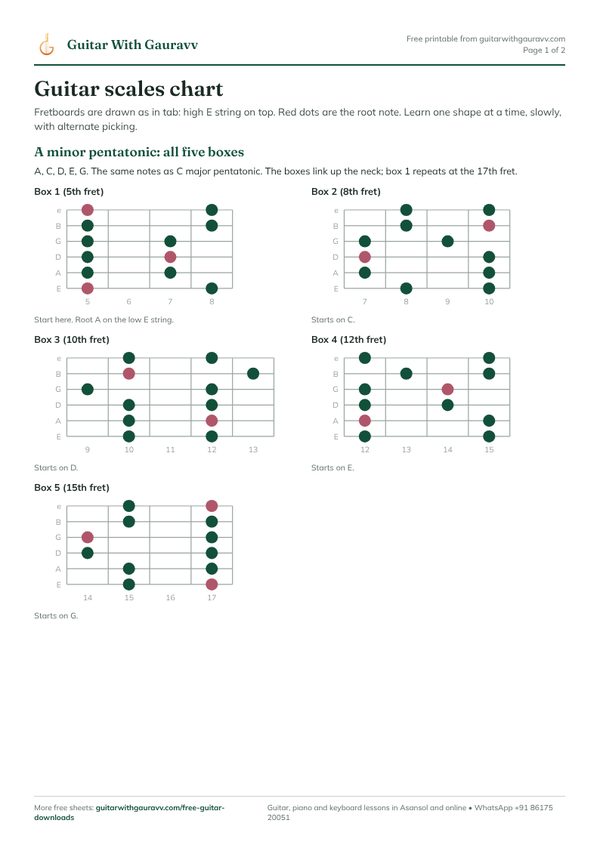
Free PDF
Guitar Scales Chart
All five minor pentatonic boxes, the blues scale, the major pentatonic and two major scale patterns.