The circle of fifths chart
How to read the circle of fifths
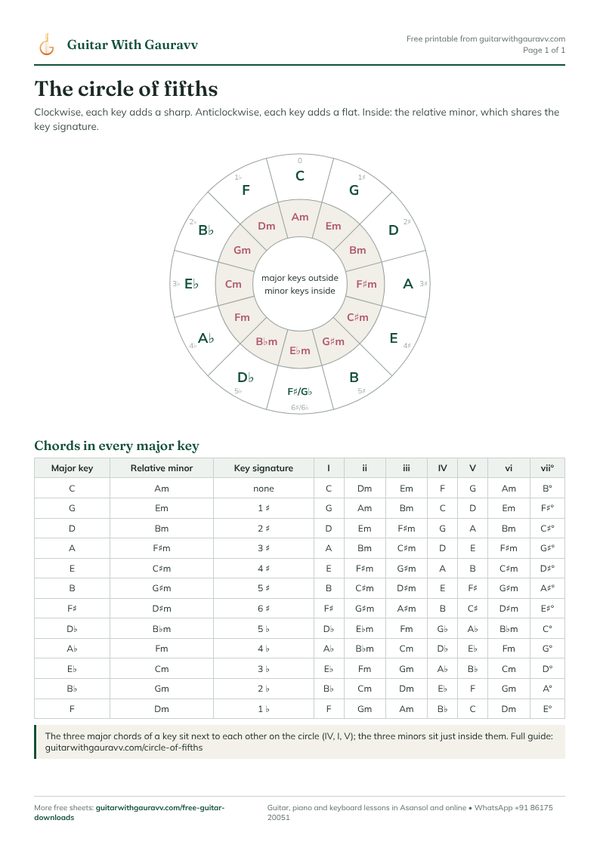
- Clockwise, each key is a perfect fifth higher and adds one sharp: C (none), G (1), D (2), A (3), E (4), B (5), F♯ (6).
- Anticlockwise, each key is a perfect fourth higher and adds one flat: F (1), B♭ (2), E♭ (3), A♭ (4), D♭ (5), G♭ (6).
- Inside the circle are the relative minor keys, which share a key signature: C major and A minor, G major and E minor.
Find the chords in any key
Pick a key. The key itself and its two neighbours are the three major chords (I, IV and V); the three minors just inside them are the minor chords (vi, iii and ii). For C: C, F and G are major; Am, Em and Dm are minor. That is the core of most songs in C.
The order of sharps and flats
Sharps are added in the order F♯, C♯, G♯, D♯, A♯, E♯, B♯. Flats are added in the reverse order: B♭, E♭, A♭, D♭, G♭, C♭, F♭.
How guitarists use it
- Transposing for a singer: move every chord the same number of steps around the circle.
- Writing progressions: chords that sit next to each other on the circle sound smooth together.
- Feeling the pull of V to I: moving anticlockwise (G to C, D to G) is the strongest resolution in music.
Put it to work with the common chord progressions, or go back to music theory for guitar.
Free PDF
Printable Circle of Fifths
The circle of fifths plus a table of all 12 major keys, their relative minors, key signatures and chords.