The hardest chord on guitar depends on where you are. For beginners it is almost always F major. For experienced players it is a wide jazz stretch, or a chord where every finger does something different. Here are the chords that trip most guitarists up, and how to beat each one.
Looking for the opposite? E minor is the easiest guitar chord: two fingers, all six strings. See the 8 easiest guitar chords.
Why some chords are hard
- Barres: one finger pressing several strings at once.
- Stretches: fingers spread across four or five frets.
- Finger independence: each finger doing something different, or crossing over another.
- Muting: keeping unplayed strings silent.
- Speed: a shape you can hold is not yet a shape you can change to in time.
1. F major: the first barre chord
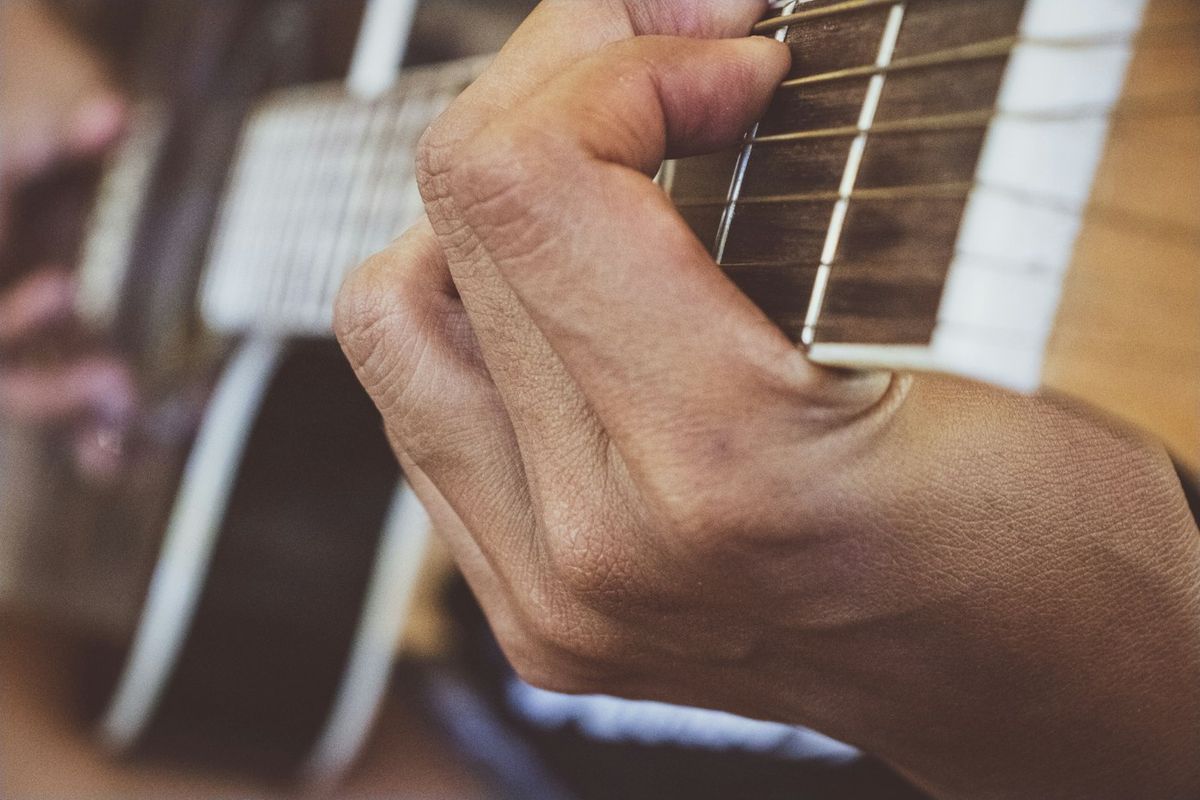
Almost every guitarist remembers fighting F. The index finger has to hold all six strings at the first fret, where the strings are stiffest. To make it easier:
- Roll the index finger slightly onto its bony side, close to the fret.
- Keep the thumb lower behind the neck, roughly behind your middle finger.
- Pull back gently with the weight of your arm instead of squeezing.
- Pick each string to find the one that buzzes, and fix only that.
- Until it works, use the small F (top four strings) or Fmaj7 from the chord chart.
2. B♭ and B major: the A-shape barre
Here the ring finger flattens across three strings while the index finger barres. Many players let the ring finger mute the high E string rather than trying to make it ring. B♭ at the first fret is harder than B at the second, because the frets are wider apart near the nut.
3. C major 9 and other finger crossovers
Chords like Cmaj9 ask the fingers to land out of their usual order. Place them one at a time, slowly, then lift and replace the whole shape at once until it lands together.
4. The Hendrix chord (E7♯9)
Made famous by Jimi Hendrix in “Purple Haze”, this chord uses four fingers across four frets and needs the low E and high E strings muted. Let the side of your first finger touch the high E, and the tip of your second finger rest against the low E.
5. Wide jazz stretches
Some jazz voicings spread across five frets. Warm up first, never force a stretch that hurts, and practise the shape higher up the neck where the frets are closer, then move it down.
How to make any hard chord easier
- Get the guitar set up. High strings make every chord harder.
- Practise the shape silently: place, lift, place again, ten times.
- Build it in parts. Play the top three strings first, then add the rest.
- Use one-minute changes between the hard chord and an easy one.
- Use a capo to move a song to a key with easier shapes.
So, what is the hardest guitar chord?
For beginners, F major. For most improvers, the A-shape barre chords like B♭. For advanced players, wide jazz voicings and chords like the Hendrix chord that need perfect finger independence. Every one of them gets easier with short, regular practice. If you are stuck on one, a private lesson usually finds the problem in minutes.
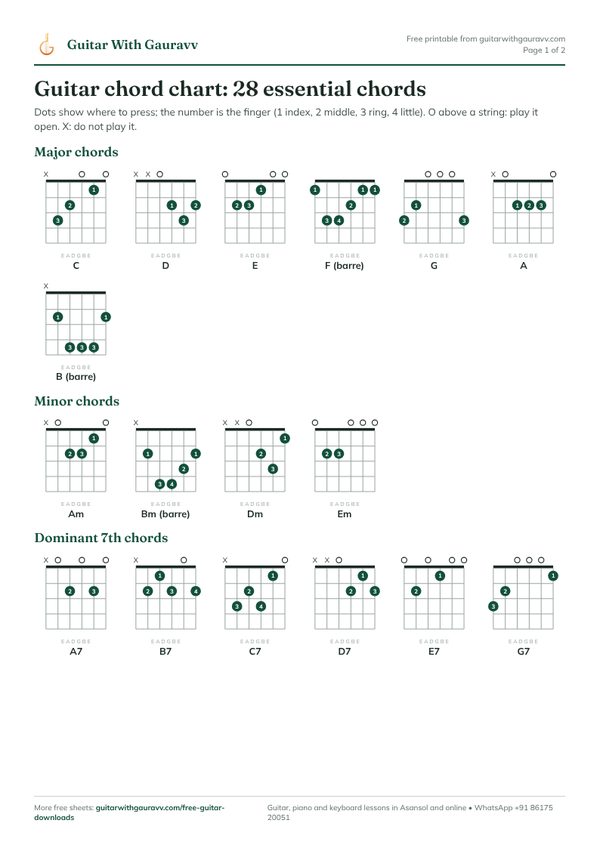
Free PDF
Guitar Chord Chart
28 essential chords on two pages: major, minor, 7th, major 7th, sus and power chords, with fingering.